


EN 388 Standard Explained: What Do the Numbers on Safety Gloves Mean?

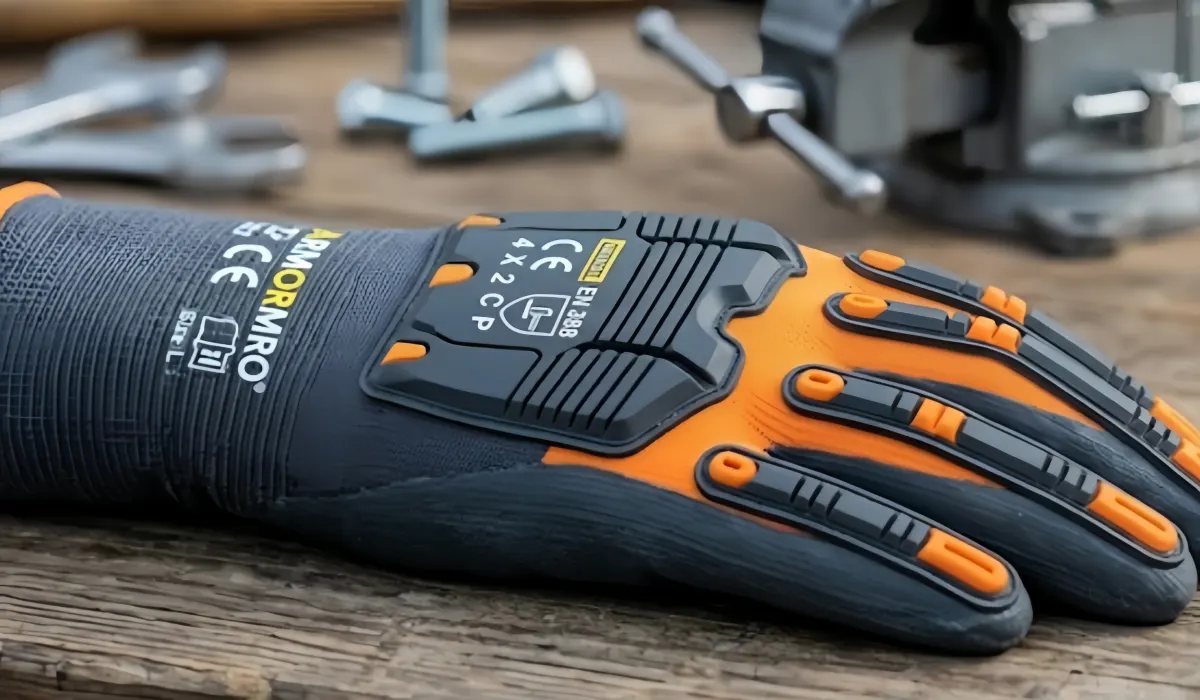
When selecting cut-resistant gloves or mechanical protection gloves, you will notice an EN 388 shield icon followed by a series of numbers and letters printed on the back or label.
This guide breaks down the EN 388:2016+A1:2018 standard to help you choose the right Personal Protective Equipment (PPE) for your workplace safety needs.
Structure of the EN 388 Marking
A standard EN 388 pictogram is followed by 4 digits and 2 letters (or X if not tested/applicable).
The standard arrangement order is:
| Position | Test Parameter | Performance Rating / Range | Test Method |
| 1st (A) | Abrasion Resistance | 1 – 4 (Higher = More durable) | Cycles required to abrade material using sandpaper |
| 2nd (B) | Coup Test Cut | 1 – 5 (Higher = More cut resistant) | Circular blade moving back and forth under constant load |
| 3rd (C) | Tear Resistance | 1 – 4 (Higher = Higher tear strength) | Force required to tear the material apart |
| 4th (D) | Puncture Resistance | 1 – 4 (Higher = Better puncture protection) | Force needed to pierce the test sample with a point |
| 5th (E) | ISO Cut Test (TDM-100) | A – F (F = Highest cut protection) | Single straight blade stroke with variable force |
| 6th (F) | Impact Protection | P (Pass) / None (Not tested or failed) | EN 13594:2015 energy absorption test |
Detailed Performance Breakdown
1. First Digit: Abrasion Resistance
-
Rating: Level 1 to 4
-
Mechanism: Measures how many cycles the glove palm material can withstand against abrasive sandpaper before a hole forms.
-
Benchmark: Level 4 requires ≥8000 cycles.
2. Second Digit: Coup Test Cut Resistance
-
Rating: Level 1 to 5
-
Mechanism: A circular rotating blade moves across the fabric sample.
-
Note: For high cut-resistant fibers (e.g., HPPE, glass fiber, or stainless steel), the blade can become dull, skewing results. In such cases, this position is marked X, and the 5th position (ISO Cut) becomes the official standard.
3. Third Digit: Tear Resistance
-
Rating: Level 1 to 4
-
Mechanism: Measures the force (in Newtons, $\text{N}$) required to tear the glove material. Level 4 requires ≥ 75N
4. Fourth Digit: Puncture Resistance
-
Rating: Level 1 to 4
-
Mechanism: Measures the force required to puncture the material with a standard steel point.
-
Important: This tests against industrial threats like nails or metal splinters and does not rate hypodermic needle resistance.
5. Fifth Letter: ISO 13997 Cut Resistance (TDM-100 Test)
-
Rating: Level A to F
-
Mechanism: Introduced in the EN 388:2016 update. Uses a fresh straight blade for every cut at precise force loads measured in Newtons ($\text{N}$).
-
Levels:
-
Level A: ≥ 2N (Light duty)
-
Level C: ≥10N (Medium duty: Automotive, logistics, assembly)
-
Level F: ≥ 30N (Extreme duty: Heavy manufacturing, glass handling)
-
6. Sixth Letter: Impact Protection
-
Rating: P or Blank
-
Mechanism: Tested for gloves featuring TPR or back-of-hand impact guards. If energy absorption passes the 5-Joule (5J) impact test, it receives a P (Pass). If left blank, impact protection is unrated.
Real-World Example
If a safety glove is marked with:
It provides the following protection capabilities:
-
4: Maximum Abrasion Resistance (8,000+ cycles)
-
X: Coup Cut test skipped due to high-performance cut-resistant fibers
-
4: Maximum Tear Resistance
-
2: Medium Puncture Resistance
-
C: Level C ISO Cut Resistance (Withstands up to $10\text{ N}$ of force)
-
P: Certified Impact Protection on the back of the hand
Need Certified Protection for Your Workplace?
At Yugasafe, we specialize in high-performance safety gloves and complete PPE solutions tailored to your business needs. Whether you require customized logo branding, specialized cut protection, or factory-direct supply, we are here to support your workforce.
-
Factory-Direct Pricing & Flexible MOQ
-
Custom Logo Printing & OEM Solutions
-
Fully Certified Safety Gear (CE, ANSI, UKCA)
👉 [Contact Our Experts Today] to get a free quote or discuss your custom PPE requirements!